
Who Governs Hays County?
Published:
Post 5 of 5 · Hays County series
A typical homeowner in Hays County is governed by Hays County, Hays CISD, the city they live in (or, if unincorporated, no city at all), an Emergency Services District, possibly a Municipal Utility District or Water Control and Improvement District, the Hays Trinity Groundwater Conservation District or Edwards Aquifer Authority, a river authority (GBRA or LCRA), the Hays Central Appraisal District, and — for most subdivisions built since 2000 — a homeowners association.
That is ten distinct entities, before adding the state and federal governments. Each one has a separate governing board. Most have separate elections. A few are not directly elected at all. Their tax rates appear on different lines of the same property-tax bill, and their decisions about water, roads, schools, and emergency services are made largely in isolation from one another.
This is the final post in a series on Hays County. The first four looked at growth, projections, water, and schools. This one looks at the structure that has to manage all of it — and at why “manage” may be the wrong word for what actually happens.
The cast
Here are the entities a Hays County address typically falls within:
Hays County government. A five-member Commissioners Court (one judge plus four precinct commissioners) handles unincorporated land use, roads outside cities, the jail and sheriff, and a long list of statutory duties. Tax rate: $0.3999 per $100 of taxable value in 2025.
A school district. Almost everyone is in Hays CISD, San Marcos CISD, or Dripping Springs ISD. Wimberley ISD covers part of the western county. Each has an elected board of trustees, separate tax rates (M&O plus I&S), and the largest combined rate of any local entity — $1.1546 in HCISD.
A city, sometimes. Kyle, Buda, San Marcos, Wimberley, Dripping Springs, Mountain City, Niederwald, and Uhland are the named cities, plus a handful of smaller incorporated places. Each has its own council, its own zoning, its own utilities. City tax rates range from $0.3576 (Buda) to $0.6515 (San Marcos). The unincorporated portion of the county — which is large — has no city government at all.
An Emergency Services District. Hays County is served by nine ESDs, plus a tenth that crosses into Caldwell County. Each has an appointed (in some cases elected) board, levies its own ad valorem tax, and contracts for fire and EMS service from local volunteer departments or municipal providers. ESDs are the modern descendants of volunteer fire associations, formalized into political subdivisions so they could levy taxes and issue debt.
A Municipal Utility District or Water Control and Improvement District, sometimes. New subdivisions in the unincorporated county are typically organized into MUDs at the time they are platted. The MUD issues bonds to finance the water lines, sewer lines, drainage, and roads — bonds paid back by future homeowners through property taxes. At least twelve MUDs operate in Hays County, plus several WCIDs (the older water-only variant). MUD tax rates vary widely; a typical supplemental rate is around $0.65 per $100, but rates above $1.00 are not uncommon in newly built developments.
The Hays Central Appraisal District. A single appointed board (with members chosen by the taxing jurisdictions whose values it assesses) sets the market value of every parcel in the county. HCAD does not levy taxes of its own, but its assessments determine the taxable base for every other entity on this list.
A groundwater conservation district. Most of Hays County is in the Hays Trinity Groundwater Conservation District, which regulates well permits and pumping. The western edge falls under the Edwards Aquifer Authority. Neither levies a property tax in most cases, but both can deny or condition the right to drill a well.
A river authority. The Guadalupe-Blanco River Authority covers the eastern and southern portions of the county; the Lower Colorado River Authority covers the northern portion. Both manage surface water supply, sell raw water to municipal utilities, and operate wastewater systems in some areas. They do not levy property taxes but they set wholesale water prices and approve contracts that determine how much water local utilities can buy.
A homeowners association, often. Almost every subdivision built since 2000 has an HOA with mandatory dues, deed restrictions, and (in many cases) the power to fine, foreclose, and govern day-to-day life. HOAs are not government — they are private contracts — but for many residents they are the most visible and demanding “authority” they interact with.
How the layers stack up on a tax bill
The cumulative property tax rate in Hays County is high by national standards and not far below the highest rates in Texas. Here is the composition for three typical address types:
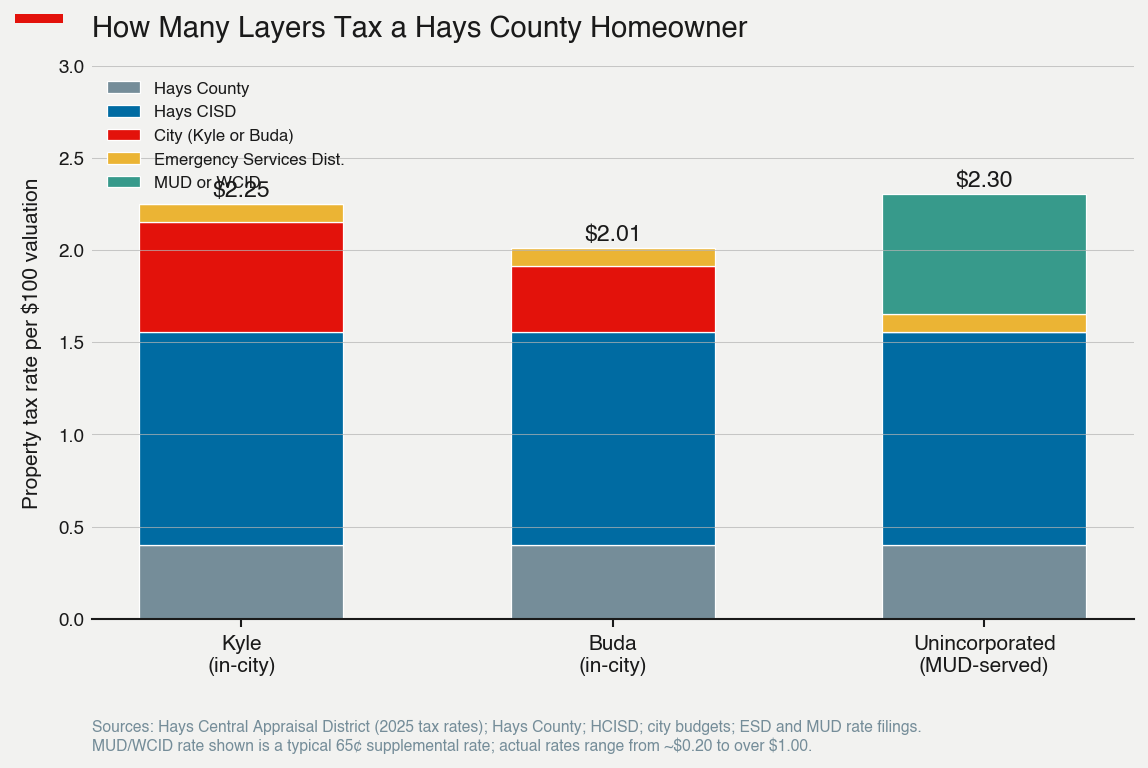
A homeowner inside Kyle’s city limits pays about $2.25 per $100 of taxable value across four entities. A Buda homeowner pays about $2.01, mostly because the Buda city rate is lower. A homeowner in an unincorporated MUD pays about $2.30 — the city rate is replaced by the MUD rate, which is often higher than what a city would charge.
The school district is the largest single component everywhere. The county and ESD are roughly constant. The variable piece is whether you live inside a city, inside a MUD, or in rural territory with neither.
And the count of governing bodies
The dollar amount is one way to count the layering. The number of distinct entities is another:
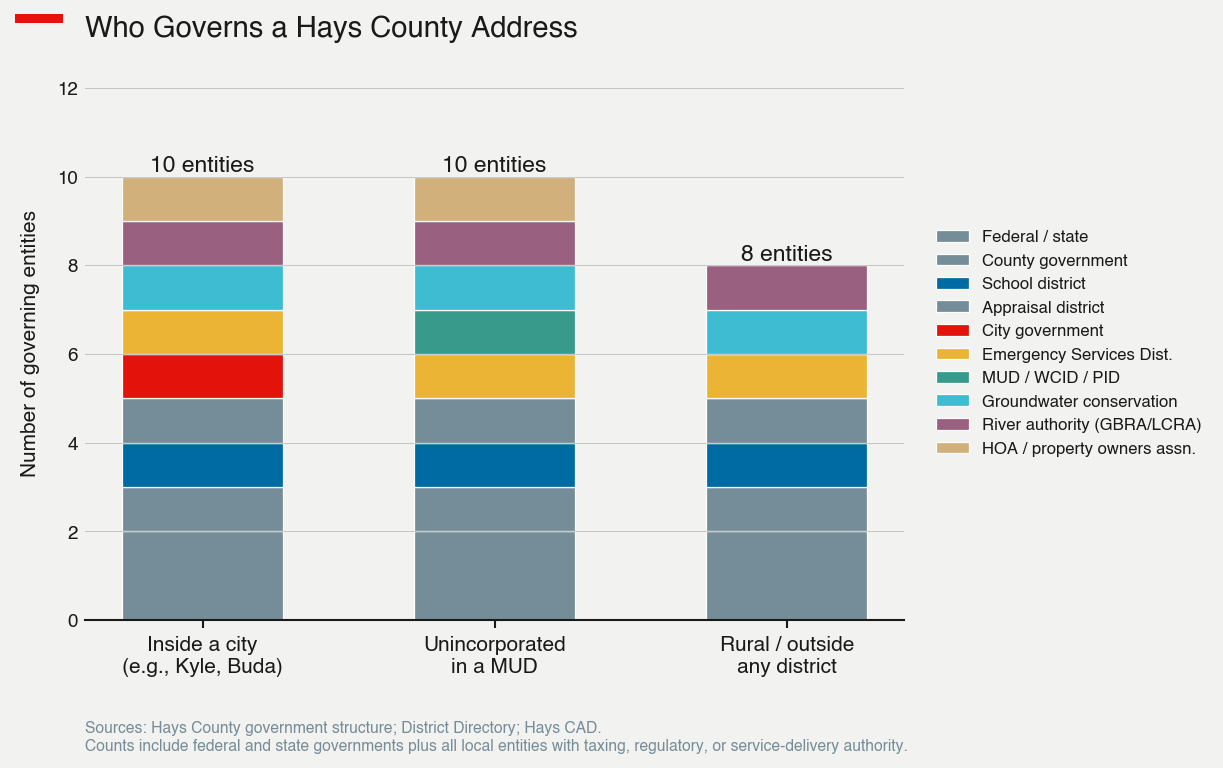
Inside a city or inside a MUD, a typical address is governed by ten entities — including the federal and state governments. Even in fully rural territory the count is eight. Each one has its own board, its own meetings, its own elections, its own budget cycle, and its own statutory authority.
Why it grew this way
The proliferation of special districts is not a Hays County phenomenon. It is a Texas phenomenon, with deep roots in two pieces of state policy.
First, Texas makes it easy to create new local entities and hard to consolidate them. The MUD statute, in particular, was written to let developers finance subdivisions without front-loading the cost onto a city or county. A developer petitions to create a MUD, the MUD issues bonds for the water, sewer, and drainage infrastructure, and the bonds are repaid by the homeowners who eventually buy the houses. From the developer’s perspective this is brilliant: it shifts the carrying cost of infrastructure off the balance sheet and onto a public entity that can issue tax-exempt debt. From the future homeowner’s perspective it shows up as a higher annual property tax bill for the first 20 to 30 years.
Second, Texas counties — outside the largest urban ones — have extremely limited regulatory authority over land use. They cannot zone. They cannot impose subdivision regulations as broad as a city’s. They cannot easily compel developers to coordinate on shared infrastructure. The Texas legislature has historically preferred to create new special districts than to empower county government, because new districts answer to local boards rather than to a county judge with broader political accountability.
The result is a system that grows fractally. A subdivision platted in 2010 produces a new MUD, a new HOA, a new water contract, and a new tax rate. Ten years later, the houses are full of homeowners who never voted on any of those decisions but now pay for them. The MUD board is elected by residents but, in the early years, residents are mostly the developer’s representatives. By the time the population shifts, the major decisions — bond issuance, rate structure, service contracts — are already locked in for decades.
The coordination problem
The first four posts in this series each ended on the same observation: Hays County’s growth is moving faster than its institutions. This post is the version of that story that has to do with the institutions themselves.
The water study commissioned in early 2026 is being done by the county, with limited authority over the MUDs, river authorities, and city utilities that actually buy and sell most of the water. The $440 million road bond approved by voters and then voided by a judge was a county-level instrument; the cities will keep funding their own roads on their own schedules. The Hays CISD budget squeeze is set by a state funding formula that the district itself does not control, and it will not be solved by any local action. The voted-down November TRE was a Hays CISD election; it had no effect on the seven other taxing jurisdictions on the same homeowner’s bill.
No single entity in this list has the authority to coordinate the others. The county judge can call meetings. The cities can pass resolutions. The school districts can lobby. The MUDs can be left out of the room and frequently are. There is no equivalent of a metropolitan planning council with binding authority, because Texas does not have that institution.
The accountability problem is the obverse of the coordination problem. When a Hays County homeowner is unhappy about their tax bill, water service, schools, or roads, the answer to “who is responsible” is rarely simple. Often it is six different entities, each pointing at the others. The homeowner has the right to vote in their school board election, their ESD board election (in some districts), their city council election, their county election, their state and federal elections — and frequently their MUD board election, which most do not realize they are eligible for. Turnout in those smaller elections is regularly under five percent.
What the alternatives are
Other states have made different choices. Many empower county government to do what Texas leaves to special districts. A handful have aggressive city-annexation laws that absorb new developments into existing city limits, eliminating the need for a parallel MUD. A few use regional service authorities to deliver water, transportation, and emergency services across multiple counties without proliferating new entities.
Texas has chosen the opposite. The 2025 legislative session, in particular, further restricted county authority — most notably by clarifying that counties cannot impose moratoriums on water-heavy development, the same provision that derailed Hays County’s effort to slow industrial water use in early 2026.
The political logic is consistent: keep authority dispersed, keep decision-making local and small-scale, let developers and property owners create new districts when they need them. The cost is the system this post describes — a homeowner governed by ten entities, a county that cannot coordinate water across them, and a tax bill that no single body is responsible for managing.
Pulling the series together
Across five posts, the same pattern has appeared in different forms. Hays County is growing very fast. The institutions managing the growth were not designed for the scale. The water study is fifteen years late. The road bond is in legal limbo. The school district’s tax base is rising faster than its enrollment, but the state forces the operating rate down, and voters have rejected the workaround. The MUDs are doing what MUDs were designed to do — building infrastructure for new subdivisions — but with no overall coordination of how the pieces fit together.
None of this is unique to Hays County. It is the Texas growth model, more visible here because Hays is growing faster than almost anywhere else in the country. The places that figure out how to manage growth at this scale, with this institutional framework, will be doing something genuinely new. The places that do not will be living inside the structure this series has described, paying ten layers of property taxes to entities that do not talk to each other, and hoping that whatever they collectively produce is enough.
The next series on Southbound 35 will move from Hays County to other Texas corridors — but the questions will be familiar. Public finance and economic development in Texas are increasingly questions of institutional design, not just policy. The institutions are the constraint.
Sources
Hays County government and structure
- Hays County: Emergency Services Districts and main county website
- Hays Central Appraisal District: hayscad.com — tax rates and structure of the appraisal district board
- District Directory: Hays County special purpose districts
Special districts (MUDs, WCIDs)
- Community Impact News: Several MUDs on ballot in Hays County
- Hays County MUD No. 4: hcmud4.org
Water authorities
- Guadalupe-Blanco River Authority (GBRA)
- Lower Colorado River Authority (LCRA)
- Edwards Aquifer Authority
- Hays Trinity Groundwater Conservation District
Texas local-government framework
- Texas Comptroller: Local economy / districts
- Texas Municipal League: Local Authority and Land Use
Property tax composition
Replication code: southbound-35/posts/hays-governance
Disclosure
This blog post was written with the assistance of Claude (Anthropic). Claude helped with data research, structuring the institutional cast, and drafting. All analysis and editorial judgment are the author’s.